
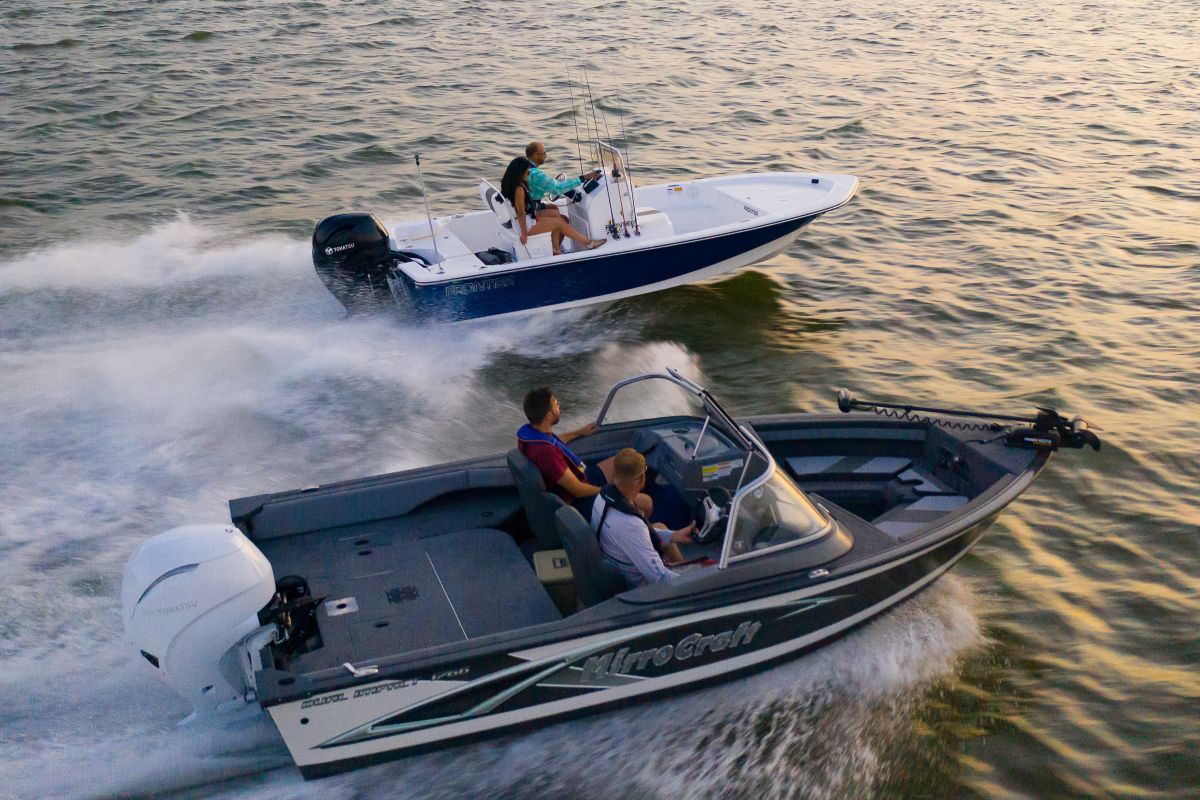
Anyone with even a small amount of boating experience knows the feeling. The unparalleled experience of wind in the face, gliding across ocean or lake water and the uncanny likeness of flying.
The Tohatsu logo of blue wings (evoking an image of the sea hawk) and its slogan of “Feel the Wind” promise that exhilaration – and their outboards have delivered it now for 70 years.
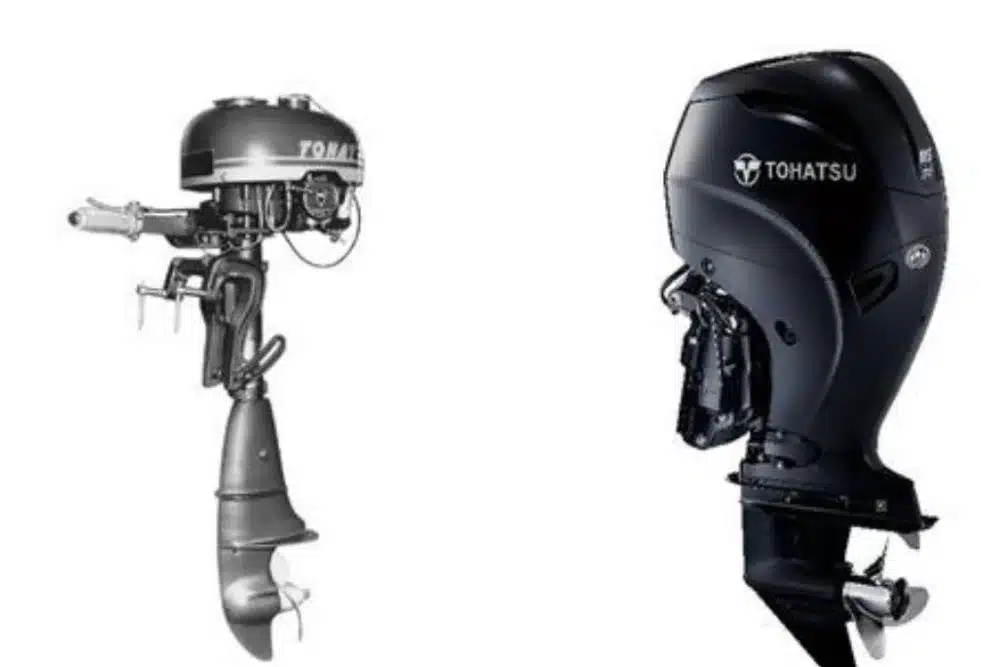
When Tohatsu put its first production outboard, the 1.5hp OB, into the water in 1956, few could have predicted the journey that would follow. Seven decades later, the Japanese manufacturer has built more than five million outboards and developed a reputation around one deceptively simple engineering objective: make an outboard as capable, durable and lightweight as possible.
The story began with a tiny two-stroke, but Tohatsu was already an experienced engine developer. The company had been working with small petrol engines since its foundation in 1922. The 1956 OB, however, represented the beginning of sustained production of outboards and the start of a marine business that would eventually become the company’s defining enterprise.
Building a Japanese outboard industry
During the 1960s, Tohatsu established a dominant position in Japan’s developing outboard market. Restrictions on imported products helped Japanese manufacturers, but Tohatsu’s success wasn’t simply a consequence of limited competition. The company was producing engines across an expanding horsepower range while developing the manufacturing expertise needed to make compact outboards reliable enough for commercial fishing, transport and recreational boating.
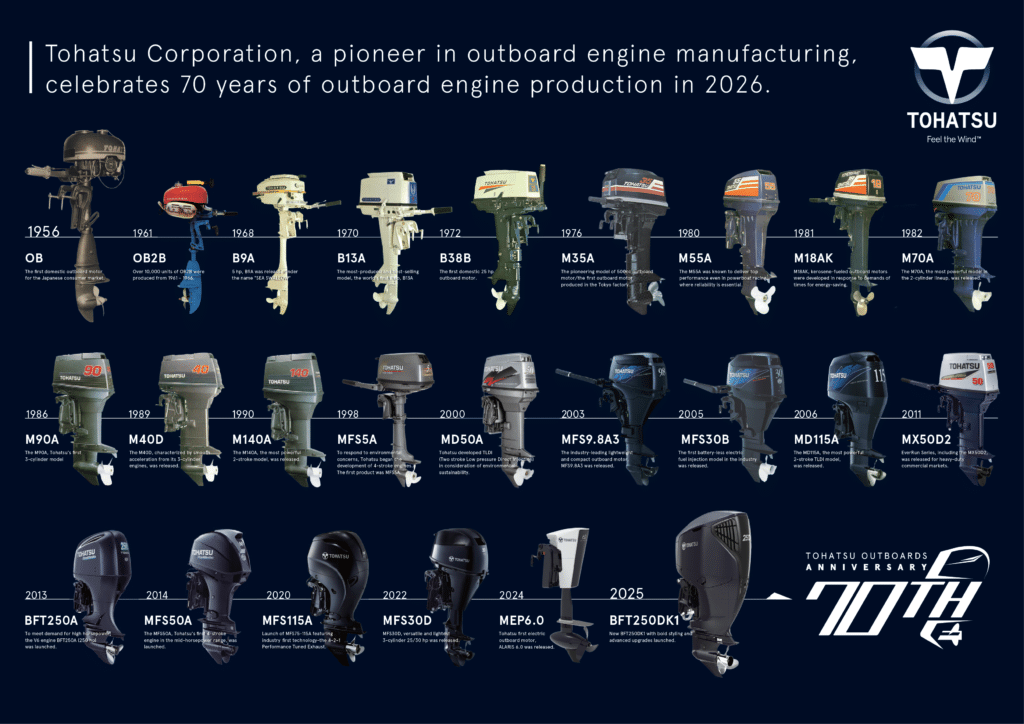
By 1970, Tohatsu had reached another milestone with the B38A, a 25hp engine described as Japan’s first 25hp outboard.
The next step was even more important: a focus on international markets.
By the 1970s, exports had become so significant that Tohatsu was selling substantially more outboards overseas than it was in Japan. The company increasingly looked to markets such as the United States and Australia not simply as destinations for existing products, but as important testing grounds for new ideas.
That international outlook produced an unusual situation for a Japanese manufacturer. During the 1970s and 1980s, new Tohatsu outboards could be announced in Australia and the United States before their introduction in Japan.
There is no secret in the Australian boating industry that many commercial fishers relied on Tohatsu’s smaller outboard range, primarily for their durability and reliability. That was no accident given that Tohatsu’s original outboard development was aimed at Japanese commercial fishermen.
Racing breeds innovation
As with much engine advancements, competition became another powerful development tool.
In the 1970s, Tohatsu entered the larger-performance end of the outboard market with the M35A, a 500cc-class engine – the first of its kind in the world. Its arrival represented a major step beyond the smaller engines that had established the company.
The M35A wasn’t simply designed to provide more horsepower. Racing gave Tohatsu an opportunity to explore the limits of engine performance, acceleration, durability and weight. Success on the water helped establish the company’s credentials internationally, and Tohatsu engines subsequently built an impressive record in boat racing and ocean competition. Tohatsu outboards cemented themselves as leaders in performance, for example, by taking consecutive wins in the world-renowned Atami Ocean Cup Powerboat Race from 1977 onwards.
Such competition is where engines faced a particularly unforgiving combination of sustained high load, salt water and rapidly changing conditions. Racing provided an engineering laboratory for Tohatsu in which performance improvements could be proven in the harshest possible environment.
That competitive experience fed directly into production engines. Models developed through the 1970s and 1980s progressively pushed Tohatsu into higher horsepower territory, culminating in engines such as the M55A, M70A and M90A. The company was moving rapidly from small portable propulsion into serious offshore power.
From two-stroke muscle to electronic control
The two-stroke remained at the heart of Tohatsu’s range for decades, but the technology continued to evolve.
The company developed engines that combined increasingly sophisticated induction and ignition systems with the compact dimensions that made two-strokes attractive. At the same time, Tohatsu was expanding its international manufacturing and OEM relationships. Its 1988 partnership with Brunswick resulted in the establishment of Tohatsu Marine Corporation, which would become an important production operation for outboards supplied into the global market.
Then came the environmental challenge.
As emissions regulations became increasingly demanding during the 1990s, the traditional carburetted two-stroke faced a fundamental problem. Tohatsu responded by developing two parallel technologies that would shape its next generation of engines.
In 1998, the company entered the four-stroke market with the compact 5hp MFS5A. Rather than simply convert existing designs, Tohatsu embarked on a broader programme of developing four-strokes that retained the characteristics customers valued in its two-strokes — particularly low weight and compact dimensions.
Then came TLDI — Two-Stroke Low-Pressure Direct Injection. Introduced around the turn of the century, the system allowed Tohatsu to retain the lightness and punch of a two-stroke while dramatically improving fuel delivery and combustion efficiency.
The result was a fascinating period in which Tohatsu offered customers three distinct approaches: traditional two-stroke technology, advanced direct-injected two-strokes and increasingly sophisticated four-strokes.
The boat becomes part of the equation
In parallel with these advances, Tohatsu’s engineering interests eventually extended beyond the engine itself.
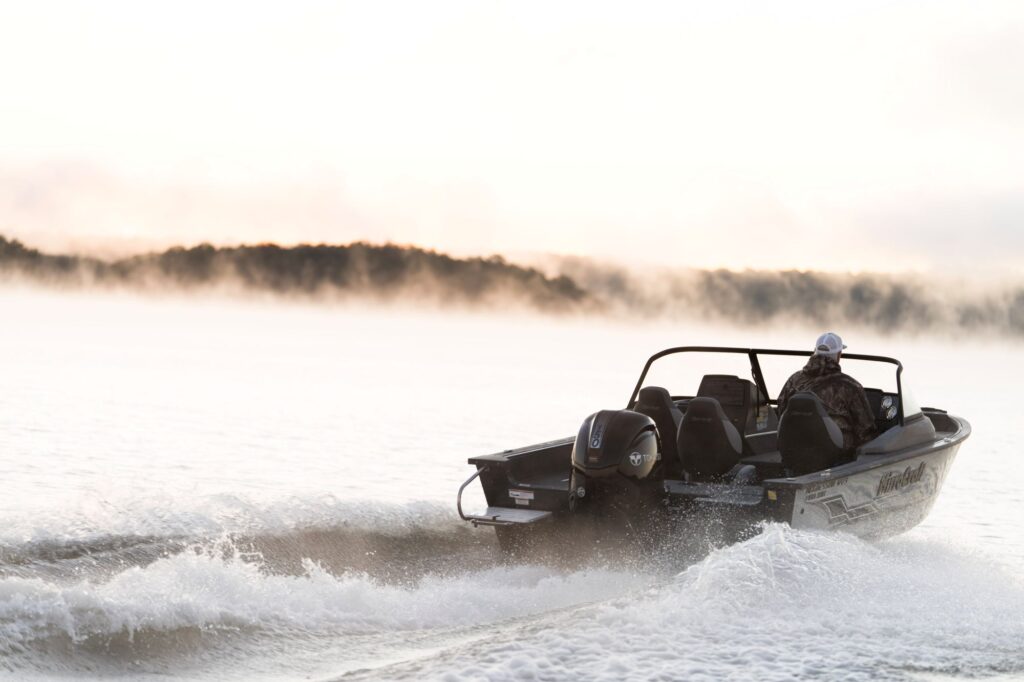
The company recognised that propulsion could not be considered in isolation from the boat carrying it. Hull shape, weight distribution, propeller selection and engine characteristics all interact to determine the performance experienced by the person at the helm.
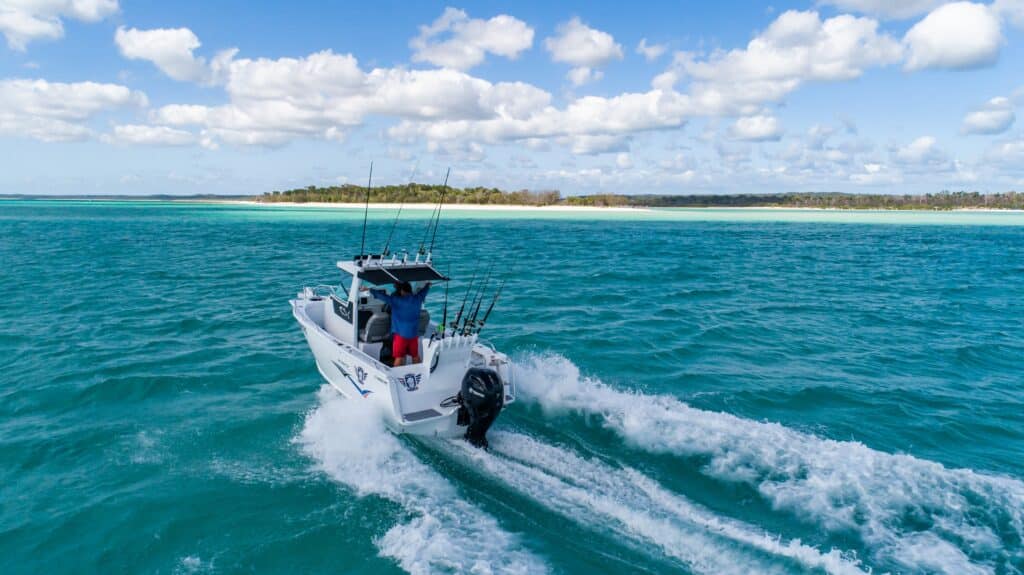
Tohatsu therefore developed its own boat-building activities, initially working with specialist partners and eventually introducing its own fishing and recreational designs. The TF series, developed during the 1990s, included boats aimed at professional fishermen as well as recreational users.
It was a relatively small part of the business compared with outboards, but it provided something valuable: direct experience of how an engine behaves when matched to a real hull.
A new generation of four-strokes
Moving into the 2000s and 2010s saw Tohatsu steadily expand its four-stroke range.
Electronic fuel injection became increasingly sophisticated, while the company’s engineers concentrated heavily on reducing weight. Models such as the MFS25 and MFS30 established the modern four-stroke direction, followed by progressively larger engines. The MFS40 and MFS50 appeared in 2014, while the company subsequently extended the range through 75, 90, 100 and 115hp models.
Weight became more than a specification on a sales brochure. It became an engineering philosophy.
A lighter outboard means less weight hanging on the transom, easier installation and removal, improved boat balance and, potentially, better acceleration and fuel efficiency. Tohatsu increasingly differentiated its products by finding ways to remove kilograms without sacrificing strength or durability.
That philosophy is particularly visible in the company’s modern four-strokes.
Investing in the future
The most tangible expression of Tohatsu’s future ambitions arrived in 2018, when the company opened its dedicated R&D Center in Kawaguchi, Saitama.
The facility brought multiple research activities together under one roof, with sophisticated testing infrastructure including a large circulating-water system for outboard testing and environmental chambers capable of testing engines in extreme temperatures. The centre represented an investment of approximately ¥5.5 billion and was designed to accelerate product development for both Japanese and international markets.
That investment says much about how Tohatsu views engineering.
The company that began with a 1.5hp outboard in 1956 is no longer simply building engines to fill a horsepower range. It is applying increasingly sophisticated research, testing and manufacturing techniques to a very specific objective: delivering maximum useful performance from minimum engine weight.
Celebrating 70 years of outboard production in 2026 has seen Tohatsu take the lead once again with the introduction of its best-in-class MFS150A four-stroke outboard – the lightest of its horsepower on the market. With a heritage of delivering the lightest, most durable and high performing outboards on the planet, Power Equipment truly can “Feel the Wind” of the continuing Tohatsu success behind it.
About Tohatsu:
Tohatsu Corporation, Japan’s oldest manufacturer of outboard motors, has been producing high-quality, durable outboard engines since 1956. To date, the company has delivered more than five million units worldwide, earning a strong reputation for reliability and engineering excellence. We remain uncompromising in our pursuit of outboard motors that are both exceptionally durable and remarkably lightweight. Our dedication to engineering excellence allows us to deliver an inspiring and highly refined engine experience to boaters around the world. For more information, please visit: https://www.tohatsu.com
About Power Equipment:
Power Equipment Pty Ltd is an Australian, family owned distributor and supplier of world-leading diesel, petrol and electric engines, power technology and a range of supporting brands within the industrial and marine industries. Officially formed back in 1990, the company’s founder had a clear goal – to bring the best engines from around the world to Australia. Since then, Power Equipment has grown to become the largest independent distributor of marine and industrial diesel engines throughout Australia, New Zealand and the South Pacific.
For more infromation on POwer Equipment visit powerequipment.com.au.